














Turmeric – the 'golden spice' – has been used for centuries in Ayurvedic medicine. It can be consumed in food, as a drink, as a paste, or in capsules or tablets. But what is golden paste, and what should you know before giving it to your dog?
🕒 6 min read
What is turmeric?
Turmeric is an Asian plant, Curcuma longa, the root of which yields a vibrant yellow powder used as a colourant and spice. It's also been used traditionally in Ayurvedic medicine for a wide range of purposes.
What are the potential benefits of turmeric for dogs?
Curcumin, one of the main active compounds found in turmeric, has been studied for its effects on inflammatory and antioxidant pathways.1 However, laboratory findings and human studies do not automatically translate into clinical benefits for dogs.
Evidence in dogs remains limited and depends heavily on the formulation being studied. In a placebo-controlled trial involving dogs with osteoarthritis, a specific turmeric extract improved the investigators' overall assessment but did not produce a significant improvement in the study's objective force-plate measure.3
A later study of a supplement containing curcumin alongside green-lipped mussel and blackcurrant leaf extract found only partial positive effects in dogs with mild to moderate osteoarthritis.4 More recently, a small study of a specific Curcuma longa extract reported improvements in pain and mobility measures in dogs with osteoarthritis, although the trial was small, did not include a placebo group and involved researchers employed by the ingredient sponsor.5
These studies are encouraging enough to support continued research, but they do not show that homemade golden paste will have the same effects as the specific turmeric and curcumin formulations used in clinical studies.
What is bioavailability and why does it matter?
Bioavailability is the amount of a substance that actually reaches its destination in the body and can, therefore, have an effect. Curcumin has low oral bioavailability because of factors including poor absorption, rapid metabolism and rapid excretion from the body.2
Researchers have found that curcumin's bioavailability can be increased when it is combined with piperine, a component of black pepper, while consuming it alongside fat may also affect absorption.2 Much of the research into these absorption strategies has not been conducted specifically in dogs, however. It is this interest in improving turmeric's absorption that helped drive the popularity of golden paste.
What is golden paste?
Golden paste is a formulation that combines oil, water, black pepper and turmeric into a loose paste that can be given with food. By combining turmeric with fat and black pepper, it aims to increase the absorption of turmeric's active ingredients into the body.
Golden paste is commonly made at home, so the amount of turmeric, curcuminoids, oil and black pepper in each serving can vary. It should therefore not be considered equivalent to a standardised turmeric extract used in a clinical study or manufactured pet supplement.
What are the benefits of golden paste for dogs?
The potential benefits of golden paste come from its turmeric content rather than from the paste itself. Based on the evidence available, it is best viewed as a way of giving turmeric rather than as a proven treatment for a health condition.
- Joint-health interest: specific turmeric and curcumin formulations have been researched in dogs with osteoarthritis, although results are limited and mixed.
- Absorption: the oil and black pepper included in golden paste are intended to improve the absorption of curcumin.
- Easy to add to food: the paste can be mixed into a dog's usual food if they tolerate the flavour.
If your dog is stiff, lame or showing signs of pain, speak to your vet rather than relying on golden paste or another supplement to manage the underlying problem.
Golden paste recipe for dogs
The following is an example of how to make golden paste at home. It is simple and requires few ingredients, but needs care, as any spills will dye surfaces and clothes readily.
Ingredients
- 50-60g turmeric powder
- 250-300ml water
- 70ml coconut oil
- 2 teaspoons finely ground black pepper
Method
- Add the turmeric to the water.
- Heat over a low heat for 8-10 minutes.
- Turn off the heat and add the coconut oil and finely ground black pepper.
- Leave to cool, then decant into a clean container.
- Keep in the fridge and use within two weeks.
How much golden paste should I give my dog?
There is no universally accepted evidence-based dose of homemade golden paste for dogs. Turmeric powders can contain different concentrations of curcuminoids, recipes differ, and ingredients such as black pepper can affect absorption. This makes a generic teaspoons-by-body-weight recommendation difficult to apply reliably.
If you are planning on supplementing your dog's diet with turmeric, discuss the appropriate product and amount with your vet. If your vet is happy for your dog to try golden paste, introduce it slowly over 7-10 days to familiarise your dog with the sight and taste and to check that it is well tolerated.
If you use a manufactured supplement formulated specifically for dogs, follow its weight-based feeding directions and do not exceed the recommended intake.
Is golden paste better than a turmeric capsule or tablet?
If you are planning on supplementing your dog's diet with turmeric, it is worth giving some thought to the formulation. Turmeric is available in various formulations, but your dog may have a preference.
Dogs aren't known for their discerning palate, but some will refuse to eat food that doesn't look, taste or smell familiar. Because of golden paste's distinctive colour, it will be difficult to hide in food. Additionally, many dogs will find the taste of pepper unpalatable.
Your dog may prefer a flavoured alternative that is palatable and more easily disguised, such as capsules or tablets.
You can also explore Healthspan's joint supplements for dogs, including turmeric formulations designed specifically for pets.
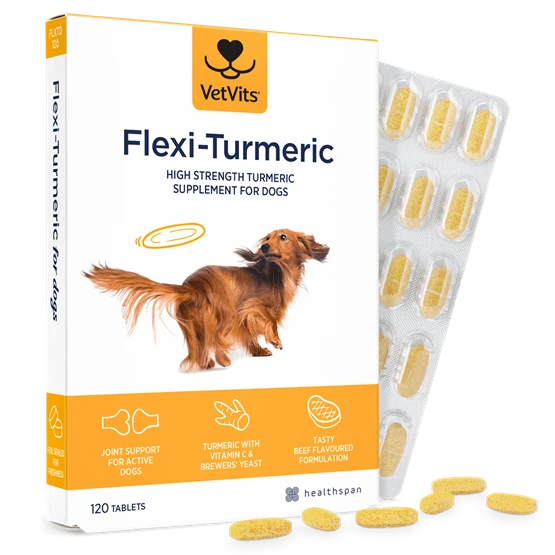
Flexi-Turmeric for Dogs
High-strength turmeric for active dogs
- 400mg turmeric root powder per tablet
- With 50mg vitamin C and 50mg brewer's yeast
- Joint support for active dogs
- Easy to give whole or crumble into food
Turmeric and safety
Turmeric-containing foods and supplements are generally well tolerated by many dogs, but safety depends on the amount given, the formulation and the individual dog. Larger amounts may cause digestive upset, and herbal supplements can potentially interact with medicines.
With homemade golden paste, it is particularly important to know how much your dog has eaten and to store the mixture correctly. Golden paste can last for up to two weeks in the fridge, but it must be kept under suitable conditions.
Feeding your dog food or supplements that are out of date or have been stored incorrectly can cause digestive problems. Always check that manufactured products are within their date and have been stored according to their instructions.
Some final thoughts on turmeric and golden paste
If your dog suffers from osteoarthritis or another health condition that you hope turmeric may help with, first discuss it with your vet. Golden paste and turmeric supplements should not replace veterinary diagnosis, prescribed pain relief or other treatment.
It is particularly important to speak to your vet before introducing a herbal supplement if your dog takes medication, is pregnant or breeding, or has an existing health condition such as liver or clotting problems. Supplements and herbal products can interact with medicines, and evidence about many of these interactions in dogs remains limited.
Frequently asked questions
What is golden paste for dogs?
Golden paste is a homemade mixture of turmeric, water, oil and black pepper. It is usually mixed into a dog's food and is intended to make turmeric easier to give while potentially improving the absorption of curcumin.
How much golden paste can I give my dog?
There is no universally accepted evidence-based dose for homemade golden paste. The concentration can vary considerably between recipes and turmeric powders, so ask your vet what is appropriate for your dog's size, health and medication before using it regularly.
Can I sprinkle turmeric on my dog's food every day?
Turmeric can be included in a dog's diet, but regularly giving it as a supplement is different from using a small culinary amount. Speak to your vet before giving turmeric every day, particularly if your dog takes medication or has an existing health condition.
Can golden paste help arthritis in dogs?
Some specific turmeric and curcumin formulations have been studied in dogs with osteoarthritis, but the evidence is still limited and results vary between studies. Homemade golden paste itself has not been shown to treat canine arthritis and should not replace veterinary treatment.
How long does turmeric take to work in dogs?
There is no reliable timeframe for homemade golden paste. Canine studies have assessed specific turmeric or curcumin formulations over periods of several weeks, and those results cannot automatically be applied to every turmeric product. If your dog is in pain or becoming less mobile, speak to your vet rather than waiting for a supplement to take effect.