










Collagen and turmeric are two popular supplements for joint health, but they work in very different ways. Here's how the evidence compares, what to look for in a collagen supplement and whether it makes sense to take both.
🕒 8 min read
There is no good evidence that collagen or turmeric is universally better for joint health. Collagen is a structural protein found throughout the body, including in cartilage and connective tissue, while turmeric contains curcuminoids such as curcumin, which have been studied in people with joint conditions including knee osteoarthritis.
Clinical research suggests that certain collagen and curcumin preparations may improve some measures of joint pain or function, but studies use different formulations, doses and treatment periods. Neither supplement should be considered a replacement for appropriate treatment of arthritis or another diagnosed joint condition.
Collagen vs turmeric at a glance
| Feature | Collagen | Turmeric / curcumin |
|---|---|---|
| What is it? | A structural protein found in tissues including cartilage, tendons, ligaments, skin and bone. | Turmeric comes from the Curcuma longa plant. Curcumin is its best-studied curcuminoid. |
| What has research looked at? | Collagen peptides, collagen hydrolysate and type II collagen have been investigated for outcomes including knee osteoarthritis symptoms and activity-related joint discomfort. | Concentrated turmeric and curcumin preparations have been investigated mainly for pain, stiffness and physical function in people with osteoarthritis. |
| Evidence picture | Recent reviews report improvements in some measures of pain and function, although study formulations and results vary. | Reviews also report promising effects on some osteoarthritis outcomes, but extracts and absorption technologies differ considerably between studies. |
| What should you look for? | Check the collagen type, source and amount. Hydrolysed collagen peptides and type II collagen are commonly used in joint-focused formulations. | Check the curcumin content and formulation rather than relying only on the headline turmeric amount. |
| Can it repair cartilage? | Collagen is an important component of cartilage, but supplements have not been proven to regrow lost or damaged human cartilage. | Turmeric has been investigated for joint symptoms, but it has not been proven to regrow damaged cartilage. |
| Can they be taken together? | Collagen and turmeric can be used in the same supplement routine, but there is not strong evidence that taking the two together is universally better than taking either alone. | |
What is collagen and how does it support joints?
Collagen is the main structural protein in the human body and provides strength and structure to tissues including cartilage, tendons, ligaments, bones and skin.
There are at least 28 types of collagen. Type I is the most abundant and is found in tissues including bone and tendons, while type II collagen is an important component of articular cartilage – the smooth tissue covering the ends of bones within a joint. Type III is also found in connective tissues including muscles, tendons and blood vessels.
The body's ability to produce collagen gradually changes with age. Dietary protein provides amino acids that can be used to make collagen, while supplements provide collagen in forms including hydrolysed collagen peptides and type II collagen.
You can explore Healthspan's range of collagen supplements for different nutritional and lifestyle needs.
What is the best collagen for joints?
There is no single type or product that has been proven to be the best collagen for everyone's joints. Research has investigated several different collagen preparations, particularly hydrolysed collagen peptides and type II collagen.
Hydrolysed collagen has been broken into smaller peptides before consumption. Type II collagen is especially relevant to joint-focused products because type II is naturally found in articular cartilage. However, different collagen products cannot be assumed to have the same effects simply because they contain the same collagen type.
If you are choosing a collagen supplement for joints, check the type and source of collagen, how much is provided per daily serving and what other nutrients the product contains. Vitamin C is particularly relevant because it contributes to normal collagen formation for the normal function of cartilage.
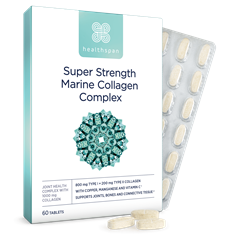
Healthspan's Super Strength Marine Collagen Complex provides 1,000mg of hydrolysed collagen peptides per tablet, including 800mg of type I fish collagen peptides and 200mg of type II chicken collagen peptides, alongside vitamin C, copper and manganese.

Super Strength Marine Collagen Complex
1,000mg collagen peptides with type II collagen
- 1,000mg hydrolysed collagen peptides per tablet
- Includes type I and type II collagen
- With vitamin C, copper and manganese
Do collagen supplements work for joint pain and arthritis?
Collagen supplements have been studied in people with knee osteoarthritis as well as physically active people experiencing activity-related joint discomfort.
A recent systematic review and meta-analysis included 11 randomised controlled trials and 870 participants with knee osteoarthritis. Overall, collagen supplementation was associated with improvements in pain and physical function, although there was considerable variation between studies.1
A separate 2023 meta-analysis focusing on collagen peptides included four trials and 507 people with knee osteoarthritis. It also found an improvement in pain compared with placebo, but all four studies were considered to have a high risk of bias, so the researchers called for better-quality trials.2
Earlier individual studies produced similar signals. In a six-month randomised trial involving 250 people with knee osteoarthritis, collagen hydrolysate improved measures of joint comfort compared with baseline, with some participants responding more strongly than others.3
Collagen has also been studied outside osteoarthritis. A 24-week placebo-controlled study involving physically active athletes reported improvements in several measures of activity-related joint pain among those taking collagen hydrolysate.4
Is collagen good for arthritis?
Research suggests that some collagen preparations may improve pain or function in people with knee osteoarthritis, but collagen supplements are not a treatment for arthritis and the evidence does not show that every collagen product will have the same effect.
If you have persistent joint pain, swelling, stiffness or reduced mobility, speak to your GP or another healthcare professional rather than relying on supplements alone.
Can collagen repair knee cartilage?
There is currently no good evidence that taking a collagen supplement can regrow cartilage that has already been lost or substantially damaged. Collagen is an important structural component of cartilage and supplements have been investigated for joint symptoms, but improvement in pain or function should not be interpreted as evidence of cartilage regeneration.
What is turmeric and how does it help your joints?
Turmeric is a spice obtained from the Curcuma longa plant and has a long history of culinary and traditional use. Its best-studied constituents are curcuminoids, particularly curcumin.
Rather than treating all turmeric products as equivalent, it is important to distinguish ordinary culinary turmeric from the concentrated turmeric or curcumin preparations used in clinical studies. Different extracts contain different amounts of curcuminoids and use different approaches to improve absorption.
You can compare Healthspan's range of turmeric supplements, including different curcumin strengths and formulations.
Does turmeric work for joint pain and arthritis?
Clinical research into turmeric and curcumin has focused particularly on knee osteoarthritis. A systematic review and meta-analysis of eight randomised trials found improvements in pain measures compared with placebo, but the researchers also highlighted the relatively small number of trials and differences in study quality.5
A larger 2014 trial involving 367 people with knee osteoarthritis compared a particular Curcuma domestica extract with ibuprofen for four weeks. Both groups improved, and the turmeric extract met the study's criteria for non-inferiority on several WOMAC measures. Abdominal pain or discomfort was reported more often in the ibuprofen group.6
A broader systematic review of dietary supplements for osteoarthritis also identified short-term signals for both collagen hydrolysate and turmeric or curcumin preparations, while emphasising that the overall quality of evidence varied substantially and that longer-term benefits were much less certain.7
These findings relate to the specific formulations and doses used in clinical trials and do not mean that every turmeric supplement will produce the same result.

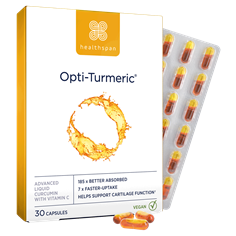
Opti-Turmeric®
Highly absorbed liquid curcumin with vitamin C
- 500mg NovaSOL® liquid curcumin per capsule
- 185 times better absorbed and 7 times faster acting than standard powdered turmeric
- With 20mg vitamin C
Collagen vs turmeric: which is better for joints?
Neither collagen nor turmeric has been shown to be universally better for joint health. They are different ingredients and have been studied using different formulations and outcomes, so there is no reliable evidence that allows a simple head-to-head winner to be declared.
Collagen may be the more obvious choice if you specifically want a collagen-based supplement and are looking for ingredients such as hydrolysed collagen peptides or type II collagen. Turmeric may appeal if you specifically want a concentrated curcumin or turmeric preparation.
For either supplement, formulation matters. With collagen, check the type, source and amount. With turmeric, check the curcumin content and how the product has been formulated, because absorption can vary considerably between preparations.
Most importantly, neither should be marketed or used as a way of rebuilding damaged cartilage or replacing appropriate treatment for osteoarthritis.
Can you take collagen and turmeric together?
Collagen and turmeric can be included in the same supplement routine, but there is not strong evidence that taking the two together works better than taking either one separately.
A systematic review of supplements used by people with osteoarthritis found short-term evidence for both collagen hydrolysate and turmeric or curcumin preparations, but that does not establish a special synergistic effect from combining them.7
If you choose to take both, follow the recommended intake and warnings for each individual product. Check the source of collagen if you have food allergies, as collagen supplements can be derived from sources including fish or chicken.
If you take prescribed medicines, are pregnant or breastfeeding, or have a medical condition, check the product warnings and speak to your doctor or pharmacist where appropriate.
Collagen and turmeric FAQs
Which is better for joints: collagen or turmeric?
There is no good evidence that one is universally better. Collagen and turmeric are very different ingredients and research has investigated different formulations and outcomes. Your choice should depend on what you want from a supplement and the individual product formulation.
What is the best collagen for joints?
There is no single collagen supplement proven to be best for everyone. Hydrolysed collagen peptides and type II collagen have both been studied in relation to joint health. Check the type, source, daily amount and any supporting nutrients such as vitamin C.
Does collagen help arthritis?
Studies in people with knee osteoarthritis suggest that some collagen preparations may improve pain or physical function. However, study quality and formulations vary, and collagen supplements are not a treatment or cure for arthritis.
Can collagen repair knee cartilage?
No oral collagen supplement has been proven to regrow lost or substantially damaged knee cartilage. Collagen is an important component of cartilage, but improvements in joint pain or function seen in studies should not be interpreted as evidence that cartilage has been rebuilt.
Is turmeric good for joints?
Concentrated turmeric and curcumin preparations have been studied in people with knee osteoarthritis, with reviews reporting improvements in some measures of pain and function. However, formulations vary considerably and results from one extract cannot automatically be applied to every turmeric supplement.
Can you take collagen and turmeric together?
They can be used in the same supplement routine, but there is not strong evidence showing that the combination works better than either ingredient alone. Follow the directions and warnings for the individual products you use.
How long do collagen and turmeric supplements take to work?
There is no guaranteed time in which either supplement will produce a noticeable effect. Clinical studies use different products, doses and treatment periods, often ranging from several weeks to several months, and individual responses vary.