










Collagen provides vital structure and support for your skin, joints and bones. Here’s what this important protein does, how the main types differ, and what to look for in a collagen supplement.
🕒 5 min read
What is collagen?
Collagen is the body’s main structural protein, providing the scaffolding for skin, cartilage, tendons, ligaments, bones and other tissues. It helps give these tissues their structure and strength.1
Collagen is a protein made up of long chains of amino acids. There are at least 28 types of collagen, three of which, known as types I, II and III, are particularly important in determining the structure, shape and strength of body tissues.
- Type I: found in skin, bones, teeth, tendons and ligaments.
- Type II: a major component of the cartilage that cushions joints.
- Type III: found alongside type I in tissues including skin and blood vessels.
Collagen is rich in amino acids including glycine, proline and hydroxyproline. Collagen chains twist around each other to form strong, rope-like triple strands. These can bind together to form fibres, while cross-linking helps create a strong supporting network.1
The word collagen derives from the Greek word for glue, kólla, describing how it holds everything together.
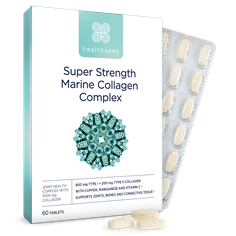
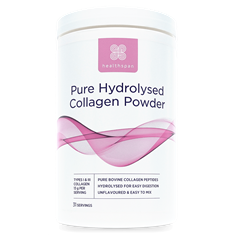
Although collagen can be obtained from eating meat and fish, collagen supplements are also popular. They offer a measured amount in formats such as powders, capsules and tablets.
What does collagen do?
Collagen helps hold the body’s tissues together. As well as being found in tendons, ligaments, cartilage, bones and blood vessels, it provides structural support within the skin.1
The female hormone oestrogen influences collagen in the skin. As levels fall around the time of menopause, skin collagen can decline, contributing to changes in firmness and elasticity.2
What does research say about collagen for skin?
Some trials and pooled reviews have reported improvements in skin hydration and elasticity with oral collagen supplements.3 However, a 2025 review found that the apparent benefits were not seen in the higher-quality or non-industry-funded studies. This means the evidence remains uncertain, and improvements cannot be guaranteed.4
When comparing options, look at the specific formula, the daily serving and the evidence behind it. Our collagen for skin guide explores this topic further.
How does collagen support joint health?
Collagen is an important part of cartilage, tendons and ligaments. Type II collagen is particularly associated with joint cartilage, while other collagen types support the surrounding connective tissues.1
Studies in people with knee osteoarthritis have investigated collagen supplements for joint discomfort. A review of 11 trials reported improvements in pain and function overall, although results varied substantially between studies. These symptom findings do not establish that supplements rebuild worn cartilage.5
Athletes have also featured in this research. A 24-week trial of collagen hydrolysate in athletes with activity-related joint pain reported improvements in selected pain measures.6
Read more in our collagen for joints guide, or compare the sources and formats in our collagen supplement range.
What about collagen supplements?
The different types and sources of collagen can make supplementation confusing. Types I, II and III are commonly discussed on supplement labels, and products are available in powder, capsule, tablet and liquid form.
Collagen supplements can be derived from animal tissues, including bovine hide and chicken cartilage, or from marine sources such as fish. The source and tissue matter: bovine hide commonly supplies types I and III, chicken cartilage is a source of type II, and fish-derived collagen is often mainly type I.7
Look for the right kind of formula for your needs. The type number helps describe the collagen, but the source, processing method, daily amount and research on the actual ingredient are also useful when comparing products.
Hydrolysed collagen and collagen peptides
Hydrolysed collagen has been broken down by enzymes into smaller fragments called peptides. This is why “hydrolysed collagen” and “collagen peptides” often appear together on labels. Other products use undenatured collagen, which retains more of its original structure; these forms should not be compared simply by the biggest number on the label.7
How much should I take?
There is no single dose that suits every collagen ingredient or purpose. Check the recommended daily serving and how much collagen it provides, rather than only the amount per tablet. Powders can offer larger gram amounts per serving, while some specialised ingredients are used in much smaller amounts. Follow the directions for the product you choose.
Why is vitamin C included?
Vitamin C is crucial for normal collagen formation for the normal function of skin, cartilage and bones.8 You can obtain it from food, and some collagen formulas include it too. When comparing products, check the full nutrient list as well as the collagen content.
Collagen FAQs
Is collagen a protein?
Yes. Collagen is a structural protein made from amino acids. It forms part of the supporting framework of skin, cartilage, bones, tendons and ligaments.1
What is the difference between types I, II and III collagen?
Type I is found in tissues such as skin, bones and tendons. Type II is a major component of joint cartilage. Type III is found in skin and other connective tissues, often alongside type I. The numbers describe different structures and locations, rather than a ranking of quality.1
Is marine collagen better than bovine collagen?
Choose according to your goals, dietary preferences and the evidence for the particular formula. Marine collagen comes from fish, while bovine collagen comes from cattle. Compare the collagen form, daily serving and any added nutrients, and check the allergen information.7
What is hydrolysed collagen?
It is collagen that has been broken down into smaller peptides. The terms “hydrolysed collagen” and “collagen peptides” usually describe the same general form. The original source and processing method can affect the final ingredient.7
How long does collagen take to work?
How do I choose a collagen supplement?
Start with your main interest, then compare the source, form, amount per daily serving, added nutrients and evidence for that ingredient. Choose a format that fits your routine. You can compare options in our collagen range.
Why take vitamin C with collagen?
Vitamin C contributes to normal collagen formation for the normal function of skin, cartilage and bones. It is one useful label check when comparing collagen formulas, alongside what you already obtain from your diet.8