









Oral health is no longer just about gleaming teeth. Maintaining a balanced oral microbiome can help support fresh breath, healthy gums and long-term mouth comfort and it may play a role in your overall wellbeing too.
🕒 5 min read
Back in the day tooth care was simple: a brisk scrub with a manual toothbrush and a spit into the washbasin. No electric toothbrush. No fluoride toothpaste. No dental floss. And certainly no concept of an oral microbiome. The consequences were sobering. Well over half way through the 20th century a third of people in England and Wales had no natural teeth.
These days understanding of oral health has progressed by leaps and bounds and clean teeth are just one part of the jigsaw. Healthy gums and soft tissues, smooth-flowing saliva, strong jaw bones and a healthy oral microbiome are all vital pieces of the whole.
So what is the oral microbiome?
The oral microbiome refers to the community of microbes that lives naturally in our mouths. Research dentist Professor Luigi Nibali, who heads up the Centre for Host-Microbiome Interactions at King’s College London, explains:
‘It’s a complex mix of bacteria, viruses, fungi and other microorganisms which have vital functions for us humans and can in some cases be linked with disease.’
Some 700 different microbial species inhabit our mouths. With the average adult’s mouth playing host to around 50 to 100 billion bacteria the oral microbiome is the second largest and most diverse microbial community after the gut. As with neighbours in any community these microbes ‘talk’, argue and vie for space, food and other resources.
Why a healthy microbiome matters
A well-balanced oral microbiome not only helps keep your mouth feeling clean, fresh and comfortable but may also impact your overall health. And it’s just about your teeth. It also includes the gums, bone, tongue, the tissues that hold your teeth in place and other structures in the mouth.
‘Optimal oral health happens when there’s a balanced relationship between the teeth, the gums, bone, tongue, the tissues that hold your teeth in place and other structures in the mouth and your oral microbiome.’
Age and factors such as smoking, changes in diet, medications, poor toothbrushing and flossing technique, are all potential culprits in disrupting the balance of oral bacteria. And when this happens – a state called dysbiosis –problems can occur., ,
Bad breath, inflamed bleeding gums, tartar build up, tooth decay and loose teeth are tell-tale signs. But it doesn’t stop there. Bacteria can be swallowed or enter the bloodstream and have been linked with low-grade, long-term inflammation throughout the body.
‘The microbes in our mouths have evolved with us humans to perform vital functions. But research clearly shows that what happens in the mouth doesn’t stay in the mouth.’
‘If too much plaque accumulates on teeth and bad bacteria are allowed to take hold it can cause problems such as tooth decay, gum disease and tooth loss. If bacteria and inflammatory chemicals travel through the bloodstream to other more distant parts they can in some cases be associated with disease.’ ,
How can you support your oral microbiome?
Maintaining a healthy balance is simpler than you might imagine. Good dental hygiene, staying hydrated, eating a healthy diet, and regular dental visits can all help. For practical guidance, see the NHS advice on healthy teeth and gums. But many of us fall short in our mouthkeeping and, if truth be told, are not always honest with our dentists, especially about flossing.
Says Professor Nibali, ‘Simply brushing and flossing will reduce the overall amount of bacteria and the risk of creating areas of the mouth where bad bacteria can grow and cause issues.’
‘Being aware of the damage that certain bacteria can cause in the mouth and, potentially, in other parts of the body, should encourage everyone to look after the health of their mouth,’ he adds.
What are oral probiotics – and how do they differ from gut probiotics?
Oral probiotics are strains of beneficial bacteria specifically formulated to help maintain a healthy microbial balance in your teeth, gums and soft tissues.
Unlike gut probiotics they don’t have to travel through the body and don’t have to survive the acidic environment of the stomach.
Early research suggests they may help support a balanced environment in the mouth by:
- Encouraging friendly bacteria to thrive, leaving less room for harmful microbes to establish themselves
- Producing natural compounds thought to help keep potentially microbes in check
- Supporting the body’s natural defences and keeping gums healthy
- Helping maintain a fresh-feeling mouth
- Working alongside everyday oral care routines to support overall mouth health
- Supporting professional treatments such as scaling and deep cleaning.
Top tips
Of course, while oral probiotics may help support oral health, on their own they are no substitute for good mouthkeeping. Here’s how to keep your mouth fresh, comfortable and healthy - for life:
- Brush well. That means two minutes twice a day with an electric toothbrush ideally one with pressure sensors and a timer – that two minutes is longer than you think. This will helps control plaque which research shows can influence microbial diversity and abundance
- Floss – or use an interdental brush. A 2026 study suggests this can help nudge the oral microbiome towards a healthier balance
- Support saliva flow. Stay hydrated; dehydration reduces saliva increasing the risk of oral problems
- Stay active. Some emerging research suggests exercise may help promote a healthier oral microbiome
- Keep up those dental appointments. Professional care can help control plaque and monitor for signs of dysbiosis
- Avoid overusing antibiotics or antiseptics. Says Professor Nibali, ‘They may be detrimental to friendly bacteria.’
- Eat for your mouth. Minimise ultra-processed and sugary foods and opt for a Mediterranean or plant rich diet. Fermented foods and probiotic supplementation may help maintain good oral health.,
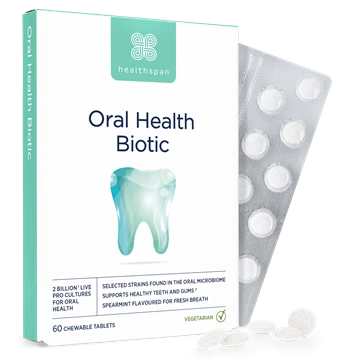
Oral Health Biotic
For healthy teeth, gums and fresh breath
- Advanced probiotic strains to support your oral microbiome
- Spearmint flavoured chewable tablets
- Added calcium and vitamins C & D3
