











Products
Subtotal
£0.00
Est. delivery
FREE
Order total
£0.00

Please enter a promotion code

Sorry, the coupon code you have entered is invalid or has expired.

Finish


The benefits of subscribing

How much do I pay?

Save up to £5 compared to RRP by subscribing to your favourite Healthspan products.

Plus, our Price Match Promise* ensures you will always receive the best available price on your subscription products, even if the one-time purchase price on our website falls below your ongoing subscription price.

How do I sign up for Subscribe & Save?

It’s simple to subscribe to a product; just select the 'Subscribe & Save' option, choose the delivery frequency you require and click 'Set up now'. Your subscription will be added to your basket like a normal order.

After you have placed the order you will receive an email confirmation with all the details. You will then be able to see your subscription details on the ‘My Subscriptions’ page in your account area on the website too.

How do I change or delay my order?

You can change the number of packs, delivery frequency or next scheduled dispatch date of your subscriptions at any time by logging in to your account and going to My Subscriptions. You can also update your delivery address and credit card details.

Can I cancel a subscription?

Yes, you can cancel your subscription at any time by contacting our customer service team on 0800 7812345. Please note subscriptions must be cancelled 72 hours before the scheduled dispatch date to avoid any charges.

How do I return an item?

UK orders can be returned for FREE for a refund of the price paid for the product. Please note that returns must be made within 30 days of purchasing and can only be accepted if the products are unopened, undamaged and in their original packaging.

For further information please view our Returns Policy.

Where Is my order?

Orders are being processed and dispatched as normal, however can be subject to routine customs checks, which can cause delays. If you are concerned about the whereabouts of your order, please contact us at customercare@healthspan.co.uk or on 0800 73 123 77. If you are calling from outside the UK please phone +44 2392 714175.

Further information can be found on our Subscribe & Save Policy and Terms & Conditions pages.


*Price match promise is based on the one time purchase price excluding new subscription discounts and voucher offers.


Where is my order?

Orders are being processed and dispatched as normal.

Orders are regularly subject to routine customs checks, which can cause delays. If you are concerned about the whereabouts of your order, please contact us at customercare@healthspan.co.uk or on 0800 73 123 77. If you are calling from outside the UK please phone +44 2392 714175.

UK
CostTarget delivery times*
UK Super Saver - SubscriptionsFREE Approx. 3-4 working days  
UK Super Saver - orders over £30
FREEApprox. 3-4 working days 
UK Super Saver - orders under £30£2.45Approx. 3-4 working days
UK Priority Service£2.95Approx. 1-2 working days
UK Courier  Â£7.95Next working day (for orders placed before 1pm)**

*Remote delivery times may vary - details listed here
**Orders placed after 1pm on Friday or over the weekend will be dispatched on Monday.

Republic of Ireland

For orders to the Republic of Ireland, please visit www.healthspan.ie 

Europe (EU)
CostTarget delivery times
Royal Mail – Priority Service£7.95Up to 10 working days*
Royal Mail – Priority Service (Subscriptions)£3.95Up to 10 working days*

Rest of WorldCostTarget delivery times
Royal Mail – Priority Service£14.95Up to 15 working days*
Royal Mail – Priority Service (Subscriptions)£3.95Up to 15 working days*

*All transit times are dependent on country of destination and may vary.

Can zinc support immune health to help prevent autoimmunity?

Jane Collins
Article written by Jane Collins

Date published 16 July 2019

Find out about the author

Back to article list

Latest articles

Zinc doesn't get a lot of press, but it's incredibly important for the healthy functioning of many parts of the body – including the immune system.

There are multiple reasons why your body needs enough zinc. It's required for protein and DNA synthesis, healthy growth in childhood, fertility, and can also reduce the risk of age-related macular degeneration.1, 2, 3, 4, 5, 6, 7

Recently, zinc's importance has been extended to immune function. It is vital in assisting the immune system in its job of fighting off invading bacteria and viruses and is used to reduce symptoms of the common cold, especially a sore throat. Zinc also has protective effects against autoimmune conditions in which the body starts attacking healthy cells.8, 9 How exactly can this mineral help to fight autoimmunity, and how much do you need? Here, we take a closer look at zinc in relation to autoimmunity.

What does zinc do?

Zinc is needed to trigger the activation of infection-fighting T cells.10 These control and regulate immune responses and attack infected or unhealthy cells, helping to ward off infection and disease.11 T cell function is highly zinc-dependent and this mineral is needed for their transformation into either 'killer' cells or 'helper/memory' T cells (which help the immune system to 'remember' a given pathogen should it encounter it again).

Zinc also fights infection by subtly reigning in the immune response, to stop it spiralling out of control and causing excessive inflammation in the body.12 It's suggested this could explain why taking zinc supplements or lozenges at the onset of a cold appears to reduce its symptoms and duration. Zinc also helps to reduce the risk of infection in the elderly, whose immune responses are less efficient, and could play a role in reducing and treating some age-related and/or autoimmune diseases.13

What does a zinc deficiency look like?

If you're deficient in zinc, this can lead to skin conditions like acne or eczema, eye and skin lesions, slow wound healing, anaemia (by aggravating iron deficiency), diarrhoea and hair loss. Other symptoms include loss of appetite, food cravings for either very salty or very sweet foods, loss of taste sensation, an abnormal or metallic taste in your mouth, and changes to your cognitive health (like impaired memory).14

Chronic (long-term) zinc deficiency can increase production of pro-inflammatory cytokines (chemical messengers in the immune system) and this is implicated in a number of chronic inflammatory and autoimmune conditions including rheumatoid arthritis, multiple sclerosis and type 1 diabetes.15, 16, 17

You can also be at risk of low zinc status as a result of excessive drinking and chronic illnesses, and conditions in which the body has problems absorbing nutrients including gastrointestinal disorders (also linked to immune deficiency) like coeliac disease, Crohn's disease, and ulcerative colitis.18

How do you increase your zinc intake?

The best way to start upping your zinc intake is with food. Good sources of zinc include beans and pulses, meat, seafood, nuts, sunflower seeds, chickpeas, greens, dairy produce and fortified foods like some breakfast cereals. Typically, most of us get enough from our diet, though it can be difficult to do this if you're vegetarian (because of the low bioavailability or take up of this nutrient from plant-based sources), or an athlete (due to intense over-exercise, which increases losses in sweat).

On top of this, you might benefit from taking a daily zinc supplement. These come in a range of forms, including zinc acetate, zinc oxide, zinc citrate, sulphate, gluconate, picolinate, orotate, and chelated zinc. The picolinate and citrate forms have been found to have higher absorption rates.19 If you do opt for a zinc supplement, a typical dose is 15mg per day, based on the EU nutrient reference value for adults. What's more, the NHS warns against taking any more than 25mg daily, so be sure to keep to the recommended dosage.20
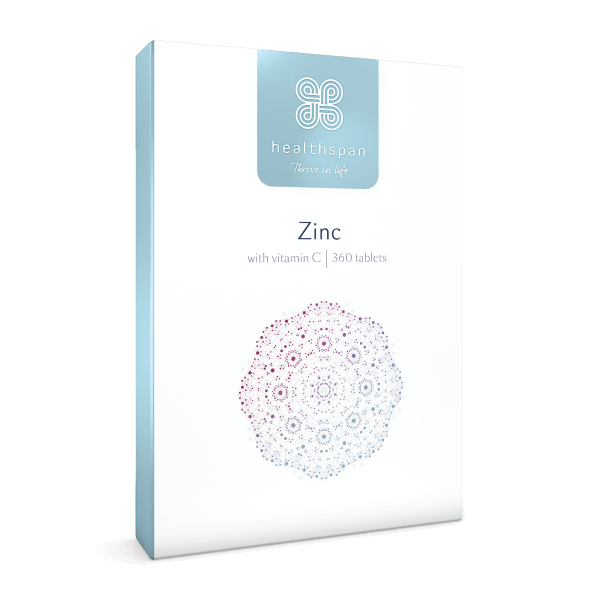
Zinc pack

Zinc with Vitamin C

Easily absorbed zinc citrate for immunity, hair, nails, skin and vision

  • Zinc citrate for easy absorption
  • Supports immunity and multiple other health areas
  • Support your health and wellbeing for less than €0.04 a day
Shop now

The bottom line: getting more zinc

We need to regularly consume zinc as it's not naturally stored in the body. A recent report suggested taking just 4mg of extra zinc daily could have a significant effect on improving cellular health and helping to fight infections and disease.21 If you know your diet is not as good as it could be, your first step is to change the foods you eat and to include more zinc-rich meals, and also to consider a supplement.

Like this article? Share it!

 
Jane Collins

About Jane Collins

Jane Collins is a journalist, author and editor specialising in women's health, psychological health and nutrition. She has more than 25 years' experience of writing for UK publications including Top Sante, Men's Health, Daily Telegraph and Evening Standard.

Smiling woman reading something on her phone

1 Zyba, S. J., Shenvi, S. V., Killilea, D. W., et al. (2017). A moderate increase in dietary zinc reduces DNA strand breaks in leukocytes and alters plasma proteins without changing plasma zinc concentrations. The American Journal of Clinical Nutrition, 105(02).
2 Age-Related Eye Disease Study Research Group. (2006). A randomized, Placebo-Controlled, Clinical Trial of High-Dose Supplementation With Vitamins C and E, Beta Carotene, and Zinc for Age-Related Macular Degeneration and Vision Loss. Archives of Ophthalmology, 119(10).
3 Fallah, A., Mohammad-Hasani, Z., and Colagar, A. H. (2018). Zinc is an Essential Element for Male Fertility: A Review of Zn Roles in Men’s Health, Germination, Sperm Quality, and Fertilization. Journal of Reproduction and Fertility, 19(02).
4
Dumrongwongsiri, O., Suthutvoravut, U., Chatvutinun, S., et al. (2015). Maternal zinc status is associated with breast milk zinc concentration and zinc status in breastfed infants aged 4-6 months. Asia Pacific Journal of Clinical Nutrition, 24(02).
5 Gupta, M., Mahajan, V. K., Mehta, K. S., and Chauhan, P. S. (2014). Zinc Therapy in Dermatology: A Review. Dermatology Research and Practice.
6 Dodig-Curkovic, K., Dovhanj, J., Curkovic, M., et al. (2009). The role of zinc in the treatment of hyperactivity disorder in children. Acta Medica Croatia, 63(04).
7 Yamaguchi, M. (2010). Role of nutritional zinc in the prevention of osteoporosis. Molecular and Cellular Biochemistry, 338(01-02).
8 Haase, H., and Rink, L. (2014). Multiple impacts of zinc on immune function. Metallomics, 06(07).
9 Sanna, A., F, D., Zavattari, P., and Valera, P. (2018). Nutrients, 10(01).
10 Kaltenberg, J., Plum, L. M., Ober-Blobaum, J. L., et al. (2010). Zinc signals promote IL-2-dependent proliferation of T cells. European Journal of Immunology, 40(05).
11 Shankar, A. H., and Prasad, A. S. (1998). Zinc and immune function: the biological basis of altered resistance to infection. The American Journal of Clinical Nutrition, 68(02).
12 Ohio State University. (2013). Zinc helps against infection by tapping breaks in immune response. Science Daily.
13 Prasad, A. S., Beck, F. W., Bao, B., et al. (2007). Zinc supplementation decreases incidence of infections in the elderly: effect of zinc on generation of cytokines and oxidative stress. The American Journal of Clinical Nutrition, 85(03).
14 Mott, D. D. (2011). Unravelling the role of zinc in memory. PNAS, 108(08).
15 Bonaventura, P., Benedetti, G., Albarede, F., and Miossec, P. (2015). Zinc and its role in immunity and inflammation. Autoimmunity Reviews, 14(04).
16 Bredholt, M., and Frederiksen, J. L. (2016). Zinc in Multiple Sclerosis: A Systematic Review and Meta-Analysis.ASN Neuro, 08(03).
17 Valera, P., Zavattari, P., Sanna, A., et al. (2015). Zinc and Other Metals Deficiencies and Risk of Type 1 Diabetes: An Ecological Study in the High Risk Sardinia Island. PLoS One, 10(11).
18 GI Society. (2011). Are You Getting Enough Zinc? GI Society.
19 Wright, M. (2014). Zinc Deficiency, Excess and Supplementation. Patient.
20 NHS. (2017). Others: Vitamins and Minerals. HS UK.
21 Zyba, S. J., Shenvi, S. V., Killilea, D. W., et al. (2017). A moderate increase in dietary zinc reduces DNA strand breaks in leukocytes and alters plasma proteins without changing plasma zinc concentrations. The American Journal of Clinical Nutrition, 105(02).