








Products
Subtotal
£0.00
Est. delivery
FREE
Order total
£0.00

Please enter a promotion code

Sorry, the coupon code you have entered is invalid or has expired.

Finish


The benefits of subscribing

How much do I pay?

Save up to £5 compared to RRP by subscribing to your favourite Healthspan products.

Plus, our Price Match Promise* ensures you will always receive the best available price on your subscription products, even if the one-time purchase price on our website falls below your ongoing subscription price.

How do I sign up for Subscribe & Save?

It’s simple to subscribe to a product; just select the 'Subscribe & Save' option, choose the delivery frequency you require and click 'Set up now'. Your subscription will be added to your basket like a normal order.

After you have placed the order you will receive an email confirmation with all the details. You will then be able to see your subscription details on the ‘My Subscriptions’ page in your account area on the website too.

How do I change or delay my order?

You can change the number of packs, delivery frequency or next scheduled dispatch date of your subscriptions at any time by logging in to your account and going to My Subscriptions. You can also update your delivery address and credit card details.

Can I cancel a subscription?

Yes, you can cancel your subscription at any time by contacting our customer service team on 0800 7812345. Please note subscriptions must be cancelled 72 hours before the scheduled dispatch date to avoid any charges.

How do I return an item?

UK orders can be returned for FREE for a refund of the price paid for the product. Please note that returns must be made within 30 days of purchasing and can only be accepted if the products are unopened, undamaged and in their original packaging.

For further information please view our Returns Policy.

Where Is my order?

Orders are being processed and dispatched as normal, however can be subject to routine customs checks, which can cause delays. If you are concerned about the whereabouts of your order, please contact us at customercare@healthspan.co.uk or on 0800 73 123 77. If you are calling from outside the UK please phone +44 2392 714175.

Further information can be found on our Subscribe & Save Policy and Terms & Conditions pages.


*Price match promise is based on the one time purchase price excluding new subscription discounts and voucher offers.


Where is my order?

Orders are being processed and dispatched as normal.

Orders are regularly subject to routine customs checks, which can cause delays. If you are concerned about the whereabouts of your order, please contact us at customercare@healthspan.co.uk or on 0800 73 123 77. If you are calling from outside the UK please phone +44 2392 714175.

UK
CostTarget delivery times*
UK Super Saver - SubscriptionsFREE Approx. 3-4 working days  
UK Super Saver - orders over £30
FREEApprox. 3-4 working days 
UK Super Saver - orders under £30£2.45Approx. 3-4 working days
UK Priority Service£2.95Approx. 1-2 working days
UK Courier  Â£7.95Next working day (for orders placed before 1pm)**

*Remote delivery times may vary - details listed here
**Orders placed after 1pm on Friday or over the weekend will be dispatched on Monday.

Republic of Ireland

For orders to the Republic of Ireland, please visit www.healthspan.ie 

Europe (EU)
CostTarget delivery times
Royal Mail – Priority Service£7.95Up to 10 working days*
Royal Mail – Priority Service (Subscriptions)£3.95Up to 10 working days*

Rest of WorldCostTarget delivery times
Royal Mail – Priority Service£14.95Up to 15 working days*
Royal Mail – Priority Service (Subscriptions)£3.95Up to 15 working days*

*All transit times are dependent on country of destination and may vary.

What your cat or dog's poop says about their health

Dr Joanna Woodnutt
Article written by Dr Joanna Woodnutt

Date published 16 June 2021

Find out about the author

Back to article list

Latest articles

Although it may be an off-putting subject, learning about your pet's poop is an important way of looking after their health, says vet Joanna Woodnutt.

As a dog owner, or if you have a cat that uses the litter tray, you're probably more than familiar with your pet's poo. This is important to help you identify when their poo is abnormal, and can give you valuable insight as to what's going on inside their bodies.

What is a normal cat or dog poo?

Your pet's poo should be firmly formed into a log shape. It should be slightly segmented in appearance, but not fully separated into chunks. It should be easy to pick up, and not too sticky, so that it doesn't leave a 'residue' on the ground.

Pets have something similar to the Bristol Stool Chart – aka a dog poop chart – which labels each poop on a score of 1-7, depending on its firmness. Normal, healthy dog poop are a score 2. Any score higher than 2 indicates varying levels of diarrhoea, whilst a '1' indicates constipation.

Dog poop chart
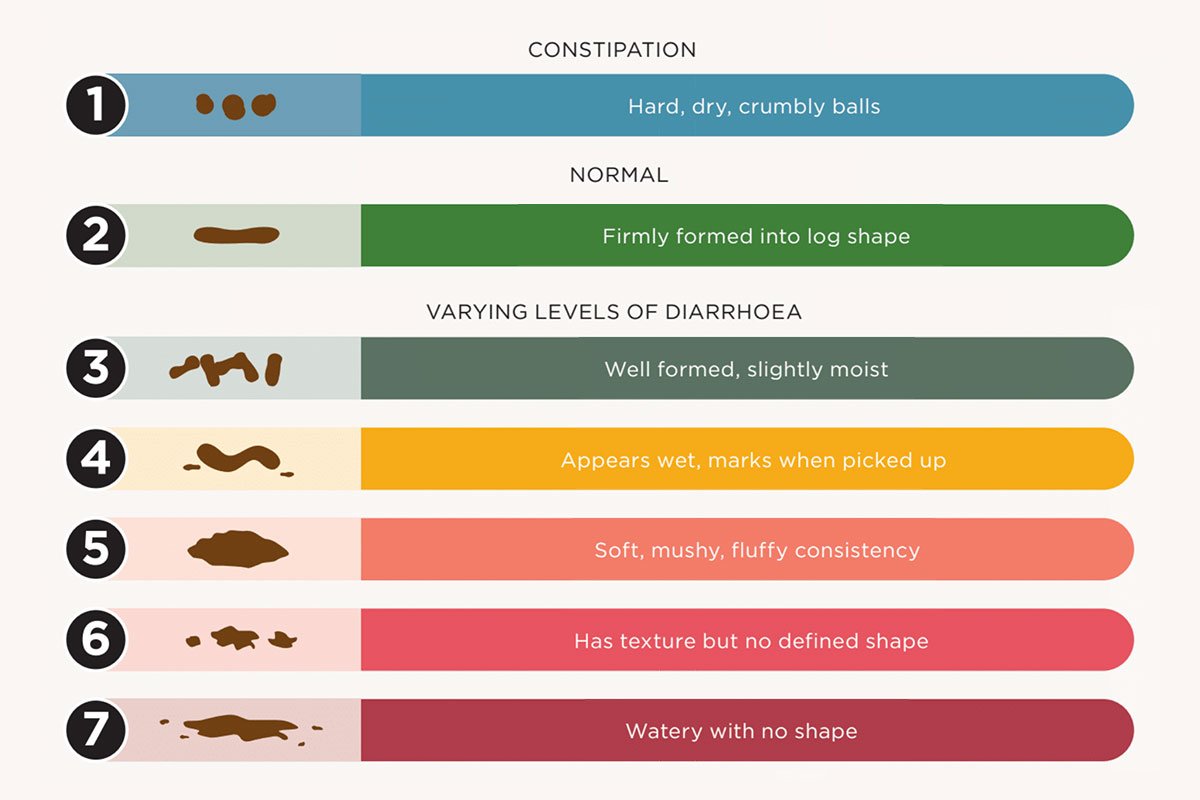
Dog poop chart

Pets have something similar to the Bristol Stool Chart - aka a dog poop chart.

When is my pet's poo not normal?

Constipation in pets

Any poos that are harder than normal are considered constipated (score 1). Constipated stools may be darker than usual and are broken into hard, dry, crumbly balls.

Constipation can be caused if the stool moves too slowly through the digestive system due to an upset. It may also be caused by diseases that cause chronic dehydration, such as kidney disease – especially in cats. I've also seen constipation in pets that refuse to toilet because 'assuming the position' is too uncomfortable, due to arthritis or spinal pain.

Diarrhoea in dogs and cats

'Normal' diarrhoea is anything softer than a score 2 poop, varying in appearance between simply unformed to a 'muddy puddle'. It can be acute (meaning it comes on quickly due to an upset) or chronic, usually due to an underlying health complaint such as food intolerance. 'Normal' diarrhoea is brown to pale brown in colour – so pay particular attention to other colours.

Coloured poop

Orange or yellow dog poop

Orange or yellow dog poop can simply be down to food dyes, but if faeces are regularly unformed and orange-yellow, especially if they're stinky, you should investigate. Exocrine Pancreatic Insufficiency and liver disease are both worries with orange poop.

Blood in dog poop

If you notice red streaks in your pet's poop, there are a couple of possibilities. Whilst one streak may just indicate that the rectum has been damaged (usually due to straining), more than a single streak suggests a more serious problem, so do get in contact with your vet.

Mucus in dog poop

Any colour of diarrhoea can also be accompanied by 'jelly' (or mucus) which suggests your pet's diarrhoea is starting lower down his digestive tract, in his colon (colitis). This isn't anything to panic about, but does suggest your pet may need some symptomatic relief, or further investigation.

Black dog poop

Black and tarry cat or dog poo is a sign of intestinal bleeding and may require urgent investigation. This may be due to a tumour or foreign body, although it can be normal after an extremely bloody or meaty meal.

How to help your pet with an upset stomach

If your pet has a mild upset stomach, it can usually be managed effectively at home – although the advice is no longer to starve dogs or cats when they have diarrhoea, as this can damage the gut further. A home-cooked bland diet has also fallen out of fashion, as it's deficient in many essential nutrients and puts your pet under further strain.

Little brown dog lying on blue sofa with eyes closed.

Feed a poorly pet a small amount of their normal food at regular intervals, as well as plenty of water.

Instead, feed a small amount of your pet's normal diet (or a tinned diet specifically formulated to deal with stomach upsets), little and often. Adding in probiotics to replace the normal gut flora can help your dog to recover faster from a stomach upset, and you will want to make sure your pet drinks plenty to keep hydrated. Consider adding water from boiling a piece of chicken as a more tempting alternative to plain water. You can also add extra water to their food.

If you're worried about your pet, a visit to the vet is usually best – especially if they have diarrhoea that persists for more than two days or is accompanied by vomiting or lethargy. You should also visit the vet if your pet's diarrhoea is recurrent, even if they get better in between.

Like this article? Share it!

 
Dr Joanna Woodnutt

About Dr Joanna Woodnutt

After graduating from the University of Nottingham, Dr Joanna Woodnutt went on to practice companion animal medicine in the Midlands, where she developed an interest in chronic diseases and client care. Since moving home to the Channel Islands, Dr Woodnutt has worked as a freelance veterinary writer and locum relief vet across the islands.

The Veterinary Content Company

Smiling woman reading something on her phone