












Strong bones, healthy muscles and a well-functioning immune system are vital throughout life to help us stay active, independent and full of vim and vigour. Yet today’s diet and lifestyle can make it hard to get the nutrients the body needs to work at its best.
🕒 7 min read
Vitamin D has long been recognised for its role in helping the body absorb calcium to support healthy bones, teeth, muscles and immunity. Yet deficiency is common especially as we get older.
Vitamin K, which contributes to normal blood clotting and the maintenance of normal bones, is also gaining interest for its ability to work alongside vitamin D, guiding calcium to where it’s required. It too is often lacking in today’s diets.
Together they make perfect partners to help support long-term health and wellbeing.
What is vitamin D3?
Vitamin D3 is one of two main forms of vitamin D used in supplements; the other is vitamin D2 (see below). It’s the form our bodies make when skin is exposed to sunlight. Because it matches the vitamin D our bodies naturally produce vitamin D3 is usually considered more effective at helping to improve vitamin D status.
Like all forms of vitamin D, vitamin D3 acts as a ‘pro-hormone.’ That is a chemical converted in the body into an active hormone - in this case calcitriol - needed to maintain:
- Normal blood calcium levels
- Normal bones and teeth
- Normal muscle function
- Immune system function
What you need to know about vitamin D
It is fat soluble: stored in body fat
Sunlight is the main source: only a small amount comes from food; most is made in the skin through sunlight exposure
There are different forms:
- vitamin D2 - ergocalciferol - comes from plants including mushrooms, yeast, fortified foods and UV-exposed mushrooms
- vitamin D3 – cholecalciferol - is synthesised in the body when sunlight hits the skin; it’s also found in small amounts in foods such as oily fish e.g. salmon, mackerel and sardines, eggs, fortified spreads, and some breakfast cereals
- 25(OH)D – calcidiol - a circulating form of vitamin D measured via a blood test
Season and latitude play a part: in the UK and other northern regions the body can only synthesise vitamin D between April and September
It doesn't stick around: blood levels of vitamin D drop quickly once the sun gets lower in the sky – in around 28 days – making deficiency more likely between October and March in the UK
Deficiency is common: one in six adults has low levels of vitamin D especially in winter and spring
Low levels aren’t always obvious: subclinical deficiency can occur without telltale symptoms and is linked with poorer bone health
Am I getting enough?
You may need a higher strength vitamin D supplement if you:
- have black, brown or darker skin (the skin pigment melanin reduces UBV absorption)
- use a high strength sunscreen or cover up with clothing
- live in the UK or another northern latitude
- spend little time outside between 11 a.m. and 3 p.m.
- are overweight or obese (vitamin D is stored in fat so less is available for the body to use)
- eat few vitamin-containing foods
- are older – skin synthesis declines with age
- live in a nursing home
- have conditions affecting fat absorption (e.g. liver disease, cystic fibrosis, coeliac disease, Crohn’s or Colitis) or have had gastric bypass surgery
What is vitamin K2?
Vitamin K2 (menaquinone) is a key member of the vitamin K family which as a whole is a group of compounds that contribute to normal blood clotting and the maintenance of normal bones.
Vitamin K works by activating proteins that move calcium around the body to places where it is needed such as the bones and teeth. , , Today’s diets often contain little K2, making it easy to fall short.
What you need to know about vitamin K
It is fat soluble: it is absorbed with fat-rich foods and stored in the body’s fatty tissue
There are different forms:
- Vitamin K1 (phylloquinone) comes mainly from plants: leafy greens (spinach, kale), vegetable oils, berries, kiwi fruit, and prunes
- Vitamin K2 is found in gut bacteria, fermented foods including some cheeses and natto (a traditional Japanese food made from fermented soya beans)
Vitamin K2 makes up around a 10-25%) of vitamin K intake: vitamin K1 makes up the rest. The exact proportion can vary by region.
The purest, most active form of vitamin K2 is MK-7. It:
- stays active in the body for several days unlike vitamin K1, whose active life is shorter
- is better absorbed and more bioavailable than other forms of K2 enabling it to reach tissues which most need it such as bones and teeth
- is mainly derived from animal-based sources
- helps support bone quality and strength
- is almost absent in processed and convenience foods; even in a healthy Western diet intake is low
Note: Warfarin and similar drugs can interfere with vitamin K absorption. Research is ongoing into how this affects calcium and bone-linked pathways in the body. Talk to your doctor if you take warfarin.
Why vitamin D3 and vitamin K2 work better together
Calcium levels in our bodies are kept within a tight range. This is essential to maintain the level of calcium needed to maintain normal bones and teeth while preventing calcium overload elsewhere.
The body operates a finely tuned system to achieve this balance with vitamins D3 and K2 playing complementary roles:
- Vitamin D3 increases the amount of calcium we absorb
- Vitamin K2 decides where that calcium should go
If vitamin K2 is lacking, the proteins responsible for managing calcium distribution stay inactive. This in turn means that calcium absorbed through the action of vitamin D may be used less effectively where it is most needed.
Think of it like a logistics system: D3 loads calcium into the system while K2 acts as the delivery and routing arm guiding it to the right destination – the bones and the teeth.
Together they create a natural synergy to support bone strength and contribute to overall wellbeing.
What the studies say:
- A Norwegian study (2015): people who had sustained a hip fracture had lower levels of vitamin K and vitamin D. While each vitamin independently reduced fracture risk together they worked in synergy
- A Japanese study (2000): 92 postmenopausal women with osteoporosis took vitamin D3 alone, vitamin K2 alone, a combination of the two, or calcium for two years. Calcium alone led to a decline in bone mineral density (BMD) in the lumbar spine; D3 and K2 each improved BMD. However, combined vitamin D3 and K2 showed a significant increase
- A Japanese study (2002): combined vitamin K2 + vitamin D3 resulted in a meaningful increase in spinal BMD in 172 post-menopausal women with low BMD outstripping the performance of each vitamin alone or a diet-only control group
These are part of a growing body of evidence examining how the two vitamins may work synergistically.
Could I benefit from a combined supplement?
A supplement containing D3 and K2 may be useful if you
- spend little time in sunlight e.g. you spend a lot of time indoors, live in a northern latitude, cover your skin for cultural or other reasons
- have a low vitamin D level naturally
- are older – older skin produces 40% less vitamin D
- are post-menopausal (women) – vitamin D deficiency is common (though under-reported) in this group
- already take vitamin D3 but want a supplement that enables better use of calcium
- are looking for broad support for normal bones, muscles and immune function.
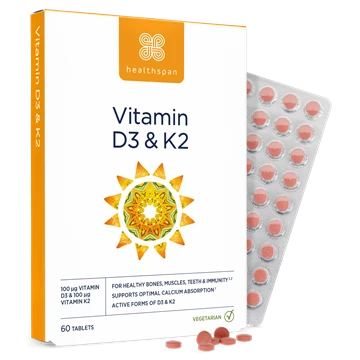
Vitamin D3 & K2
For immune, bone and blood health with optimal calcium absorption and delivery.
- 100 µg vitamin D3 and 100 µg vitamin K2 per capsule
- Uses the pure, active form of K2 called MK-7
- Supports normal bones, muscles, immunity and blood clotting
Why choose Healthspan’s formulation?
Healthspan’s new formulation combines two well-researched active forms of vitamin D and vitamin K:
- vitamin D3
- vitamin K2 as MK-7
Each is provided at 100 micrograms (the maximum daily amount recommended for UK supplements).
The two nutrients have been chosen to support the body’s natural processing of calcium as follows:
- Vitamin D contributes to normal blood calcium levels and the maintenance of normal bones and teeth
- Vitamin D contributes to the maintenance of normal muscle function and the function of the immune system
- Vitamin K contributes to normal blood clotting and the maintenance of normal bones.
All Healthspan supplements are crafted from the purest ingredients and rigorously tested in the UK to meet the highest standards of quality and safety. Each product is scientifically backed and designed for maximum effectiveness and absorption without any unnecessary additives.
Explore our joints, bones & vitamin D support
Vitamin D3 & K2
High-strength vitamin D3 and K2 (MK-7) for optimal calcium absorption and delivery.
View product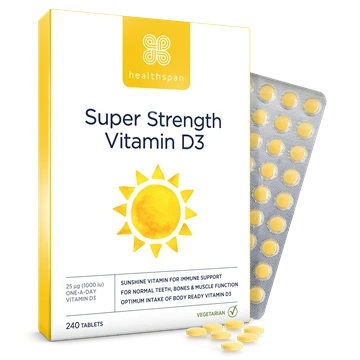
Super Strength Vitamin D3
25 µg vitamin D3 for immune health, muscle function, bones and teeth.
View product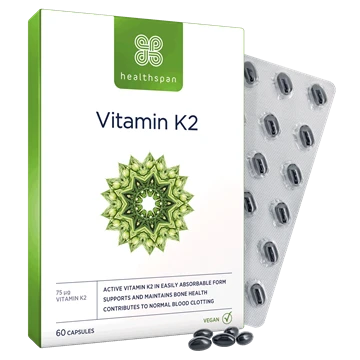
Vitamin K2 75µg
75 µg vitamin K2 (MK-7) to support normal bones and blood clotting. Vegan friendly.
View product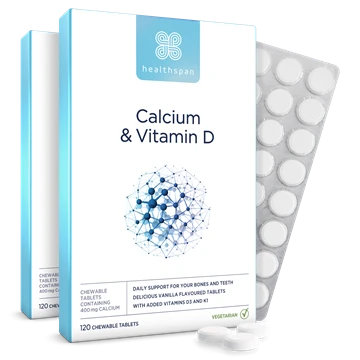
Calcium & Vitamin D
Chewable vanilla tablets with calcium, vitamin D3 and K1 to support strong bones and teeth.
View product