












Dr Hilary Jones separates the myths from the facts about testosterone, explaining what it does in the body, why levels can change with age, when to speak to your GP, and how targeted nutritional support may help support men’s health and vitality.
🕒 6 min read
Common myths about testosterone
It is an irrefutable fact that testosterone is a vital hormone in men’s sexual and general health, but there remain widespread misconceptions about its overall role, its links to the so-called “male menopause” and its effects on male behaviour, physicality and libido.
It is simply not true that men who lose their hair have higher than normal testosterone levels compared to everyone else, nor that you must take anabolic steroids in order to become a bodybuilder, or that macho behaviour and aggression are always signs of excess hormone in the bloodstream. These are simply popular myths.
What testosterone does in the body
The truth is that testosterone is not just a sex hormone. It is certainly necessary for normal male physical sexual characteristics and sex drive, for fertility and erectile function, but it also plays an important role in wider male health, including muscle strength, energy and motivation, mood, cognitive focus, bone health and healthy ageing. When circulating levels fall, these functions can be significantly impacted.
Testosterone, ageing and symptoms
In recent years, there has been a growing interest in the notion of testosterone deficiency and its remedies. This has been fuelled by talk of “the midlife crisis”, “the andropause” and the “viropause”. But these descriptions are misleading, because there is no real equivalent in men of the female menopause. Male hormone levels do not decline nearly as dramatically as oestrogen levels do in women as they approach their late 40s.
In men, testosterone levels fall much more gradually, by around 1% per year between the age of 30 and 40, but this rarely causes symptoms. Ten years later, however, it may be a different story, although again this is not necessarily caused by declining testosterone levels alone.
By this time, many men report diminishing sex drive, more frequent erectile dysfunction, mood swings or depression, anxiety, irritability and insomnia. Many experience general fatigue, lack of motivation, enthusiasm and energy, and become aware of a ballooning waistline and “man boobs”.
Other factors that can affect energy, mood and libido
There may be many reasons for these symptoms other than testosterone deficiency. It is not simply a normal part of ageing. Stress, anxiety and depression, smoking or excess alcohol, coronary heart disease, money worries, work pressures and relationship problems can all take their toll and contribute.
Lack of adequate restorative sleep, reduction in exercise routines and the treadmill of long hours and commuting understandably impact on energy levels and joie de vivre. Of all the organs, the brain is the most powerful driver of libido, so we need to guarantee ourselves sufficient rest and relaxation to give our bodies a fighting chance.
For more advice on staying well in midlife, read our guide to what all men over 40 should know about their health.
If these underlying issues can be identified and resolved appropriately, so much the better. But in the absence of such lifestyle influences, a chat with the GP about these non-specific symptoms might reasonably result in blood tests to measure testosterone levels and diagnose or rule out testosterone deficiency.
Testing testosterone and considering TRT
That said, hormone levels famously fluctuate significantly and can be influenced by many internal and external factors. Consequently, results are not always easy to interpret and strict guidelines, such as those recommended by the world-renowned Endocrine Society, need to be followed when weighing up the risks against the benefits and working out a monitoring plan to follow up on treatment.
Are serum testosterone concentrations unequivocally and consistently low? Are levels normal but bound to proteins in the blood, so not “free” and biologically available to exert their effects on the body? Was the blood test taken before 10 o’clock in the morning and do the results correlate with symptoms?
Do additional hormone assays point to a problem arising from the testes themselves, or from the pituitary gland and hypothalamus at the base of the brain, which stimulate those organs? Are urological assessments going to be made to check on PSA levels and any enlargement of the prostate?
These are questions that need to be answered, and frequently the GP may refer a patient to an endocrinologist for specialist evaluation before testosterone replacement in the form of injections or a gel is considered. For more information, read our guide to the real side effects of testosterone replacement therapy for men.
Testosterone replacement therapy should only be considered after appropriate medical assessment. Taking testosterone inappropriately may have serious side-effects, including acne and oily skin, fluid retention, increased hair growth on the body, thicker blood, a higher risk of stroke or heart attack, reduced sperm production and enlargement of the prostate.
Testosterone deficiency, or hypogonadism, may well be diagnosed in some cases, especially where there is obesity or type 2 diabetes. Happily, many men will be reassured to know that their levels are well within normal limits and that testosterone replacement therapy would neither be required nor necessarily free of side-effects.
But that is certainly not to say that appropriate nutritional support might not help support general wellbeing, energy and vitality. There is emerging evidence to suggest that certain ingredients may have a role to play.
Shilajit and testosterone support
In one randomised controlled trial, published in the peer-reviewed medical journal Andrologia, purified Shilajit given to healthy volunteers aged between 45 and 55 for 90 days showed significant increases in both total and free testosterone levels compared to placebo, with well-maintained levels of pituitary hormones.
Another study in men with low sperm counts treated with the same supplement increased overall sperm count as well as sperm motility, suggesting a contributory natural role when considering the management of male fertility.
Shilajit was also shown to improve fatigue-induced reduction in muscle strength in another trial published in the Journal of the International Society of Sports Nutrition.
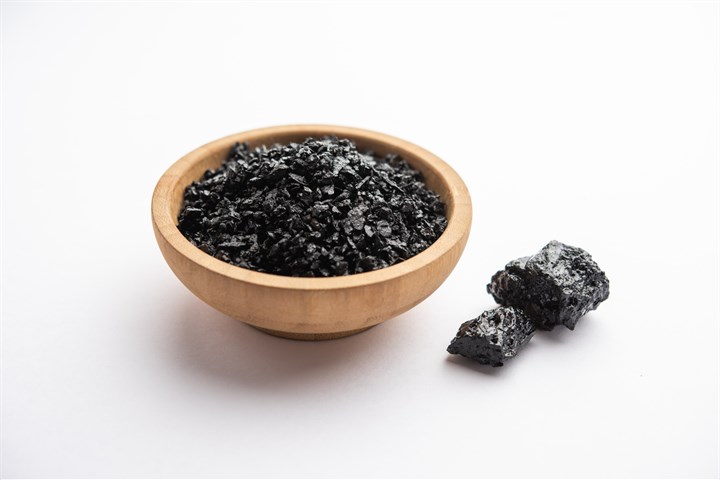
So what is this interesting supplement, Shilajit? It is a rock exudate derived from sedimentary rocks from the Himalayan mountain ranges, a substance which has been formed slowly over long periods of time, consisting of decomposed plant matter and minerals compressed over thousands of years.
Regarded as a “supervitalizer” in Ayurvedic medicine for many years, it is rich in fulvic acid, urolithins linked to healthy ageing, trace minerals and antioxidants.
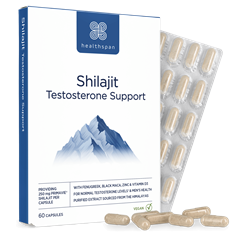
But not all Shilajit is the same. Healthspan’s branded PrimaVie® Shilajit contains purified, science-based extract in a standardised form designed to ensure steady and reliable levels. It also contains the botanicals black maca and fenugreek, both of which are linked to men’s health and vitality, as well as zinc for fertility, vitamin D3 for muscle function, and iodine and boron for cognitive support, energy and metabolism.
For wider nutritional support, see our guide to the best vitamins and supplements for men's health.
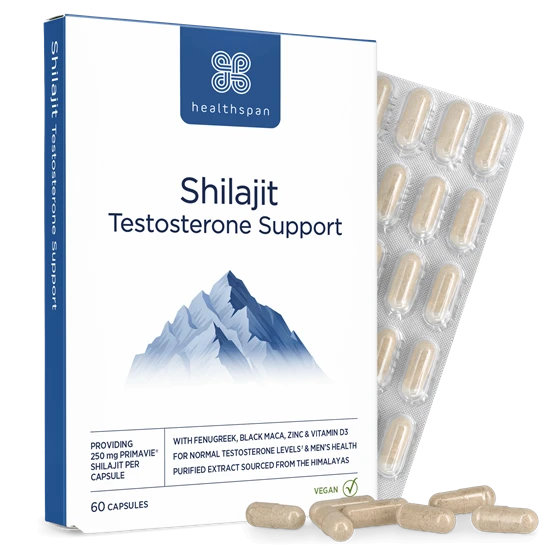
Shilajit Testosterone Support
For healthy testosterone levels
- PrimaVie® Shilajit, fenugreek and black maca
- For sexual health, energy, muscle and cognition
- With zinc picolinate and vitamin D3
The bottom line
Testosterone deficiency certainly exists and is becoming increasingly well-researched and understood. Its diagnosis and management, however, are far from straightforward and need to be carefully assessed. When carried out correctly, treatment can be a game-changer and restore a person’s vitality, energy, motivation, sex drive and overall wellbeing.
Just as men can help to understand and support their female partner who may be going through their menopause and the years leading up to it, women are probably even more attuned and capable of spotting signs of possible testosterone deficiency in their men. It is something that men are often reluctant to admit to or talk about. Nor are the kinds of non-specific symptoms we have been talking about restricted to older men.
This is where PrimaVie® Shilajit comes into its own. Most men do not require testosterone replacement therapy, and this supplement is not a treatment for a medically diagnosed condition nor a substitute for TRT.
But for thousands of men, particularly those over the age of 50 who just need a boost, an injection of energy and the reassurance that a food supplement can support their cognitive focus, mood, muscle function, bone health and overall male wellbeing, the clinical research into purified Shilajit and testosterone levels will be of great interest.