














Is turmeric good for arthritis? Research suggests that certain turmeric and curcumin extracts may help with pain, stiffness and physical function in people with knee osteoarthritis. Here's what the science tells us.
🕒 7 min read
The strongest evidence for turmeric and arthritis relates to knee osteoarthritis. Reviews of randomised clinical trials suggest that some turmeric and curcumin preparations may reduce pain and improve physical function compared with placebo, although formulations, doses and study quality vary considerably.12
That does not mean turmeric has been proven to treat or cure arthritis, rebuild damaged cartilage or work equally well for every type of arthritis. Supplements should also not replace appropriate medical care. NICE recommends therapeutic exercise and, where appropriate, weight management as core treatments for osteoarthritis.5
Turmeric and arthritis at a glance
| What has been studied? | What does the evidence suggest? | Important to know |
|---|---|---|
| Knee osteoarthritis pain | Systematic reviews report reductions in pain with some turmeric and curcumin preparations compared with placebo. | The studies use different extracts and formulations, so results cannot automatically be applied to every turmeric supplement. |
| Physical function | Some trials report improvements in measures of everyday knee function. | Most evidence is short term and relates specifically to knee osteoarthritis. |
| Joint stiffness | Meta-analyses have reported improvements in WOMAC stiffness scores compared with placebo. | Turmeric has not been shown to rebuild lost joint cartilage. |
| Inflammatory markers | A 2025 meta-analysis found reductions in CRP and TNF-alpha, two markers associated with inflammation. | Other inflammatory markers did not change significantly and biomarker changes are not the same as proving treatment of arthritis. |
1. Turmeric may help with knee osteoarthritis pain
Pain is one of the main reasons turmeric and curcumin have been investigated in people with osteoarthritis.
A 2025 systematic review and meta-analysis brought together 10 randomised controlled trials involving 786 people with knee osteoarthritis. Overall, Curcuma longa preparations improved pain scores compared with placebo, although the researchers highlighted differences between the studies and called for further research into optimal formulations and doses.1
A separate meta-analysis of 15 studies involving 1,670 participants also found that curcuminoids improved pain scores compared with placebo.2
This is encouraging, but it is important to distinguish evidence about specific preparations used in clinical trials from claims about turmeric supplements generally. A result seen with one extract cannot automatically be applied to another.
2. It may improve physical function
Joint health is about more than pain. Knee osteoarthritis can also make everyday activities such as walking, climbing stairs and getting up from a chair more difficult.
Systematic reviews have found improvements in physical function scores among people taking certain turmeric or curcumin preparations compared with placebo.12
Another review of 16 randomised trials involving 1,810 adults also reported improvements in knee pain and physical function. However, results varied substantially between studies and the overall risk of bias was considered moderate, so the size of the true effect remains uncertain.4
If you have osteoarthritis, turmeric should be considered alongside – rather than instead of – the measures recommended for managing the condition. NICE identifies therapeutic exercise as a core treatment and recommends weight management where appropriate.5
3. It may help with joint stiffness
Stiffness is another common osteoarthritis symptom and is frequently measured in clinical studies using the WOMAC questionnaire, which assesses pain, stiffness and physical function.
A 2022 systematic review and meta-analysis of curcuminoids alone found statistically significant improvements in WOMAC stiffness scores compared with placebo, alongside improvements in pain and function.2
These findings do not mean turmeric repairs damaged cartilage. Current clinical evidence is primarily about symptoms and function rather than regrowth of joint tissue.

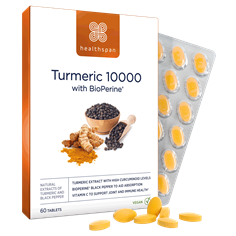
Turmeric 10000 with BioPerine®
High-strength turmeric extract with black pepper and vitamin C
- 500mg turmeric extract, equivalent to 10,000mg fresh turmeric root
- Provides 475mg curcuminoid compounds and 5mg BioPerine®
- 40mg vitamin C, which contributes to normal collagen formation for the normal function of cartilage
4. Curcumin may influence some inflammatory markers
Curcumin has attracted considerable research interest because of its effects on biological pathways associated with inflammation.
A 2025 systematic review and meta-analysis of 21 randomised studies involving 1,705 people with knee osteoarthritis examined blood markers of inflammation. Compared with control groups, curcumin was associated with lower levels of C-reactive protein (CRP) and tumour necrosis factor alpha (TNF-alpha). However, there were no significant differences for several other markers, including IL-6, IL-1 beta and erythrocyte sedimentation rate.3
This is useful mechanistic evidence, but changes in blood markers should not be interpreted as proof that turmeric treats arthritis or prevents joint damage.
What should you look for in a turmeric supplement?
One reason turmeric research can be difficult to compare is that products vary considerably. Culinary turmeric powder, concentrated turmeric extract and isolated or specially formulated curcumin are not the same thing.
When comparing supplements, look at the amount of turmeric extract or curcumin provided, the curcuminoid content and the formulation. Some products combine turmeric with black pepper extract, while others use liquid or other delivery technologies.
You can compare the different options in Healthspan's turmeric supplement range.
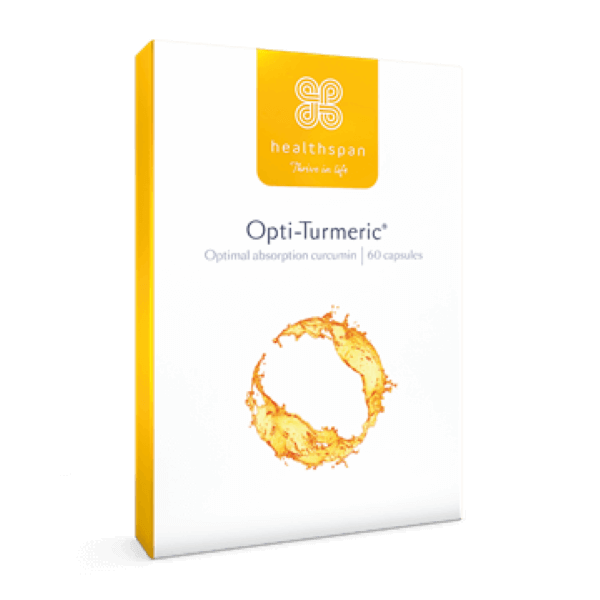
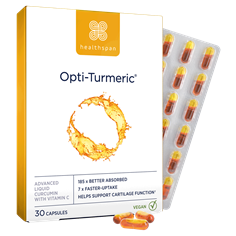
Opti-Turmeric®
Highly absorbed liquid curcumin with vitamin C
- 500mg NovaSOL® liquid curcumin per capsule
- 185 times better absorbed and 7 times faster acting than standard powdered turmeric
- With 20mg vitamin C
How much turmeric should you take?
There is no official UK recommended daily dose for turmeric or curcumin supplements for arthritis. Clinical studies have used a wide range of extracts, formulations and doses, so the number of milligrams alone does not tell you whether two products are equivalent.
Follow the recommended intake on the individual supplement rather than trying to reproduce the dose from a clinical trial. Do not exceed the stated intake.
Are turmeric supplements safe?
Turmeric is widely used as a culinary spice, but concentrated supplements provide very different levels of turmeric and curcuminoids.
The UK's Committee on Toxicity has reviewed reports of liver injury associated with turmeric and curcumin supplements and concluded that rare, unpredictable reactions may occur in susceptible individuals.6
If you take prescribed medication or have a medical condition, speak to your doctor or pharmacist before taking a turmeric supplement. If you experience an adverse reaction, stop taking it and seek medical advice.
Turmeric and arthritis FAQs
Is turmeric good for arthritis?
The strongest evidence is for certain turmeric and curcumin preparations in people with knee osteoarthritis. Reviews suggest possible improvements in pain, stiffness and physical function, but results vary and turmeric has not been proven to treat or cure arthritis.
What type of arthritis has turmeric been studied for?
Most of the stronger clinical evidence relates to osteoarthritis, particularly knee osteoarthritis. This evidence should not automatically be applied to rheumatoid arthritis or other inflammatory joint diseases, which have different causes and treatments.
Can turmeric repair damaged joint cartilage?
No. Turmeric and curcumin have been studied for outcomes such as pain, stiffness and physical function, but there is no good evidence that taking a turmeric supplement regrows cartilage that has already been lost or damaged.
How long does turmeric take to work for joints?
There is no guaranteed timeframe. Clinical trials have used different turmeric and curcumin formulations for periods ranging from several weeks to several months, and individual responses vary.
How much turmeric should I take for arthritis?
There is no official UK recommended turmeric dose for arthritis. Different studies use different extracts and formulations, so follow the recommended intake on your chosen product rather than copying a dose from a clinical trial.
Can I take turmeric with arthritis medication?
If you take prescribed medicines, check with your doctor or pharmacist before using a turmeric or curcumin supplement. Concentrated supplements can interact with medicines and are different from the amounts of turmeric normally used in food.